
Where She Stands
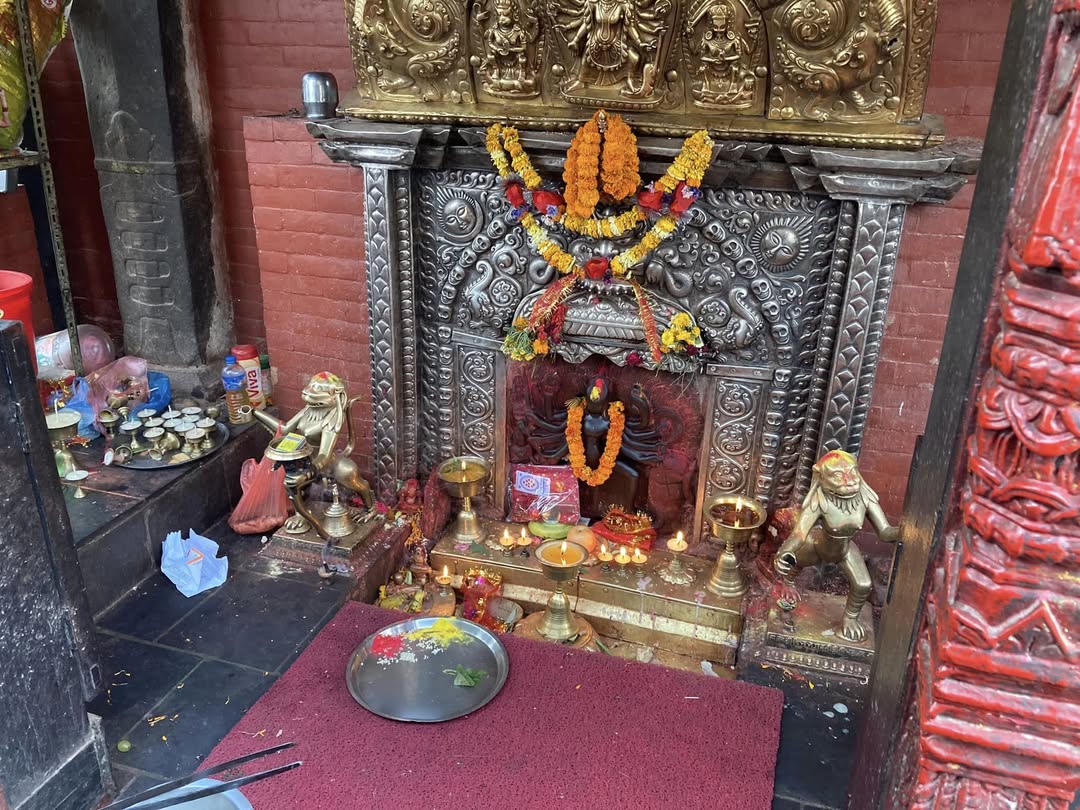
Śobhā Bhagavatī sits at Nirmal Tīrtha, on the bank of the Bishnumati, in a position that tells you a good deal about her before you have learned anything else. Directly opposite her, across the river, stands the temple of Indrāyaṇī, one of the eight mātṛkās that mark the periphery of Kathmandu. Above her, on the rise, is the Vajrayoginī temple of Vijayaśvarī. She is held between the two.
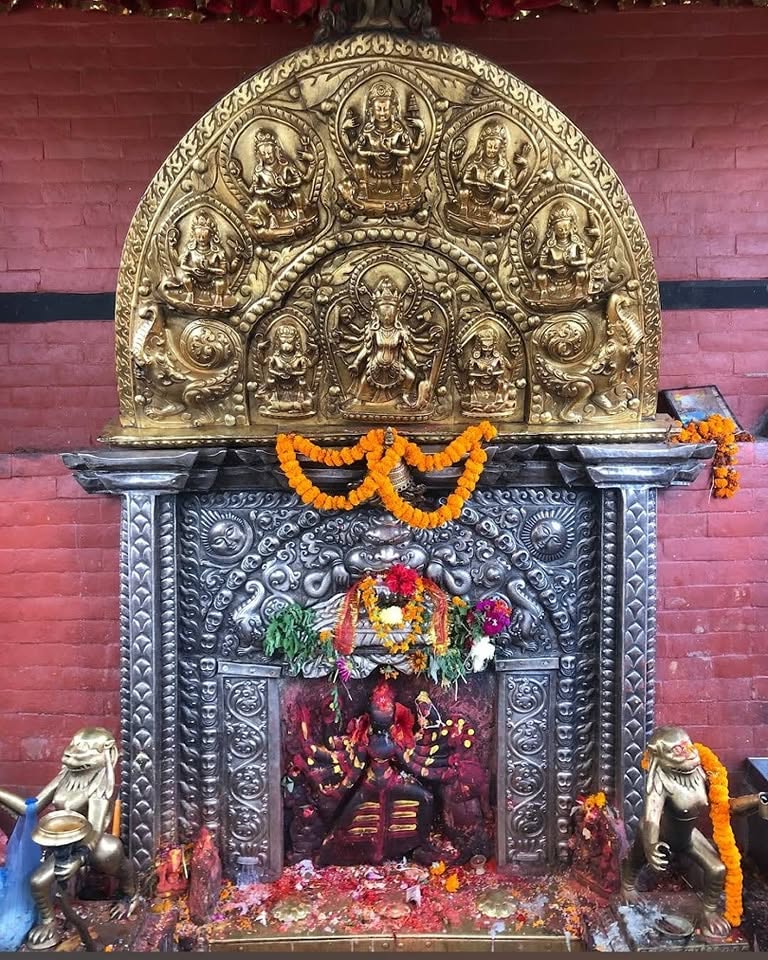
The shrine at Nirmal Tīrtha: the dark image set within a silver-worked frame, with the guardians on either side and the day's lamps set out before it.
She is a mātṛkā, but she does not belong to the set of eight. This distinction is worth holding onto, because visitors who have learned the aṣṭa mātṛkā scheme tend to assume that any fierce mother goddess in the Valley must be one of them, and the Valley's actual arrangement is a great deal more populated than that. In the local Kathmandu rendition of the story she is counted among the five children of Indrāyaṇī — which is a neat way of accounting for the fact that she stands directly across the water from her.
She is a cemetery goddess, and fierce. This is not a shrine for the faint-hearted, and it has never pretended to be one.
Nirmal Tīrtha and the Charnel Ground
The site itself carries two distinct sets of associations, one Buddhist and one tantric, and they do not compete with each other so much as sit in layers.
According to the Svayambhū Purāṇa, Nirmal Tīrtha is one of the places visited by Krakucchanda Buddha. That places the ground in the deep mythic history of the Valley, alongside the other tīrthas that the Purāṇa records.
The same location is also identified with the Karṇavīra cemetery, which appears in Tibetan sources as one of the significant charnel grounds for dharma practice. Charnel grounds are not incidental in that literature. They are where certain kinds of practice are specifically undertaken, and a site named among them is being marked as a place of a particular capacity rather than merely a place where the dead were burned.
Taken together: a fierce cemetery goddess, standing at a tīrtha visited by a Buddha of a previous age, on ground named in Tibetan texts as a charnel field for practice, across the river from a mātṛkā and below a Vajrayoginī.
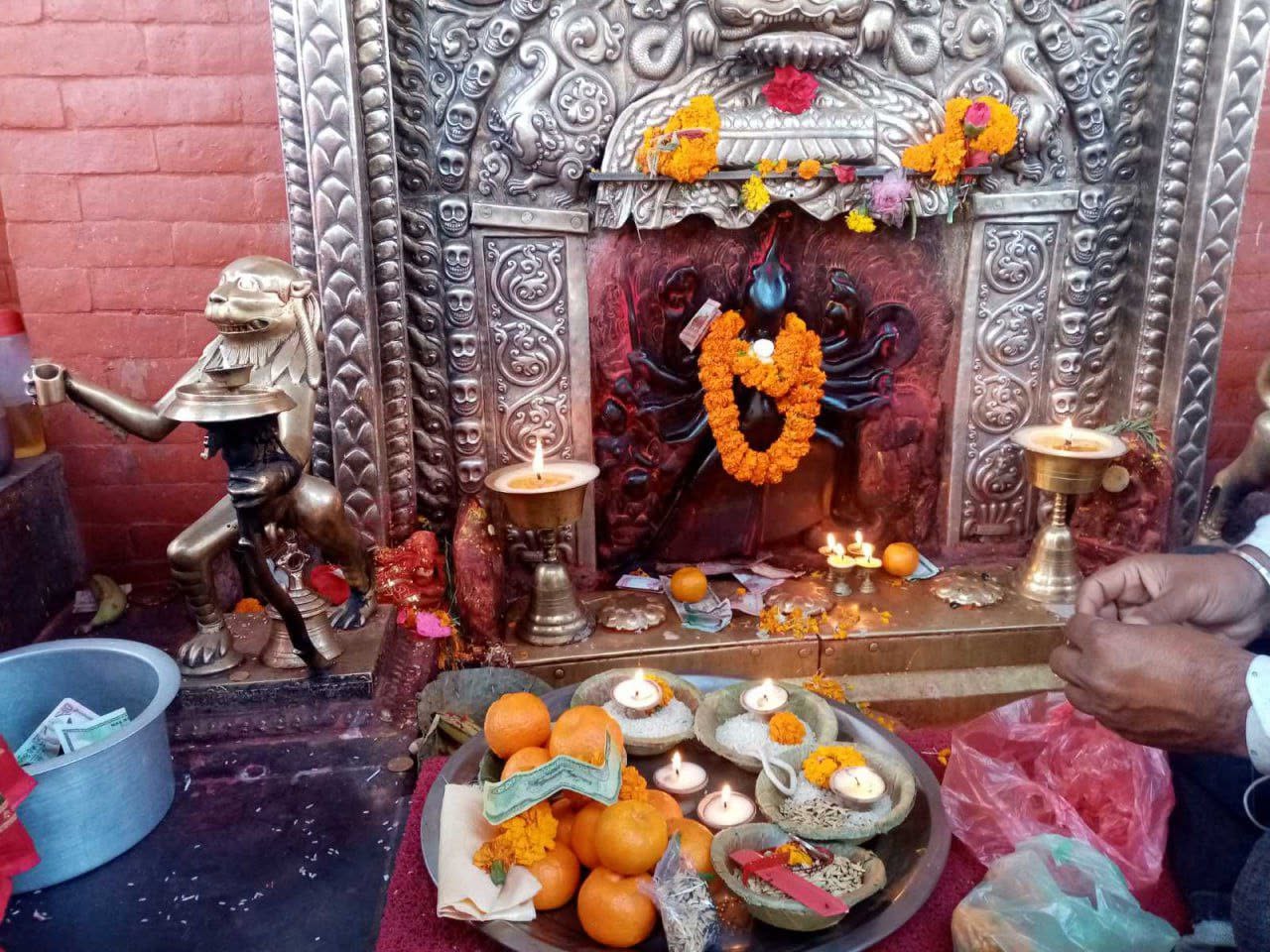
Lamps, marigold and offering plates before the image.
What Is Seen There at Night
An uncle of mine, a devotee of Jamālī Lokeśvara and Ākāśa Bhairava, used to go to Śobhā Bhagavatī at night. He told me that he never once found the place empty. There were always practitioners there, of all kinds, occupied with their own sādhanā, and no one enquiring into anyone else's business.
He also told me that on one occasion, at midnight, the Bishnumati stopped. Not slowed — stopped, for a split second, and then resumed. He understood it as the goddess making her presence felt.
I record this because accounts of this kind are how the temples of Nepal are actually held and transmitted. They are not decorative additions to the historical record. A person who reads the inscriptions and the Purāṇas but never hears what an uncle saw at midnight has assembled something accurate and understood very little of it.
The Four Bhagavatīs and the Severed Limbs
Śobhā Bhagavatī is the youngest of four Bhagavatī images made by the same hands, and the legend attached to their making is among the harder ones in the Valley's repertoire.
It begins with Queen Navasāgar, who commissioned the making of Palanchok Bhagavatī. When the image was finished, to ensure that its design could never be reproduced anywhere else, she had the craftsmen's right hands cut off.
With their left hands, they made Nala Bhagavatī. Their left hands were then severed as well.
They were made to build Naxal Bhagavatī using only their right legs, and the queen took those too.
With nothing remaining but their left legs, they made Śobhā Bhagavatī.
Whatever one makes of the legend as history, it is doing something specific: it binds the four images into a single lineage and it accounts for their descending order without appealing to date or dynasty. It also says something unsparing about what it cost to produce an image that could not be copied.
Śobhā Bhagavatī stands close to the line of the mātṛkā circuit and is taken in on the round, which I arrange and lead on request: customized pilgrimage.