
Who the Eight Mātṛkās Are
Mātṛkā means mother. The eight are the mother goddesses who arise from the bodies of the great deities — Brahmā, Śiva, Viṣṇu, Indra, Kārttikeya, Varāha — and each of them carries the weapon, the mount and something of the temperament of the deity she came from, though in a form that is a good deal fiercer and considerably more immediate than his. Where the source deity presides, she acts.
In Sanskrit they are Brahmāyāṇī, Rudrāyaṇī, Vaiṣṇavī, Indrāyaṇī, Kaumārī, Mahālakṣmī, Cāmuṇḍā and Vārāhī. A reader who has met the eight elsewhere in South Asia will notice the names shifting slightly from region to region — Māheśvarī standing where Rudrāyaṇī stands here, Indrāṇī where we say Indrāyaṇī — and the variation is old and unremarkable. In the Kathmandu Valley a third layer sits on top of both: each of the eight has a Newar name by which her own neighbourhood has addressed her for centuries, and it is that name, not the Sanskrit one, that you will hear if you ask someone on the lane outside where you have arrived.
What distinguishes the Valley's mātṛkās from mātṛkās elsewhere is that here they are not only images housed inside temples, to be visited one at a time as devotion or occasion brings you to them. They occupy fixed positions on the ground, and those positions have a shape and a logic that only becomes visible when you consider all eight of them together.
Kathmandu Is Laid Out as a Sword
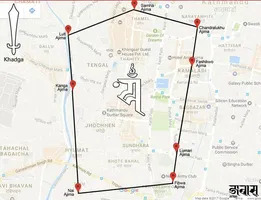
The ancient cities of the Valley were planned rather than accumulated, and the plan was not only a matter of streets and quarters. The historical texts describe Kathmandu as laid out in the shape of a khadga, a ritual sword, with the periphery of the blade marked out by the eight mātṛkā pīṭhas. This is not a poetic gloss applied afterwards by someone admiring the map. The old painted city maps of the Valley show the figure plainly, drawn as a sword with the goddesses set along its edge, and if you take a modern satellite view and join the eight seats with straight lines, the same blade appears, oriented the same way. The two pictures, separated by a few hundred years and by every possible difference in method, agree with each other.
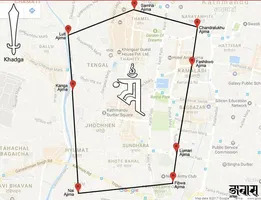
The eight seats plotted on a modern map. The blade appears once the positions are joined.
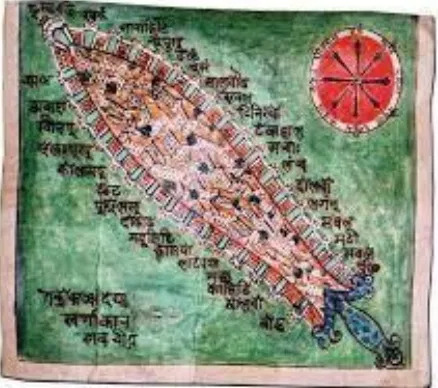
The city in the older painted tradition: the same sword, with the periphery marked and the quarters named in Newar script. The hilt sits to the south-east and the point runs north-west, as it does on the modern plot.
The same arrangement was applied at Patan and at Bhaktapur. Each of the three cities carries its own ring of eight standing at its periphery, which means the Valley holds three complete circuits rather than a single one, laid down according to a shared principle but each belonging to its own city and its own community.
Understanding this changes what a visit actually consists of, and it is the thing most visitors never learn. A mātṛkā pīṭha is not a destination in the sense that a famous stūpa or a great temple is a destination, somewhere you travel to and stand before and travel back from. Each seat is a point on a boundary, and the goddess who sits there is positioned facing outward, away from the settlement she guards, holding a line that runs through her and on to the next seat. Visiting one on its own is a little like reading a single word of a sentence. You are standing at one point of an enclosure whose whole purpose is that it encloses.
Protection, and the Other Half of It
The mātṛkās protect the residents of the city and bless them when they act virtuously. That much is said readily, and it is the half of the arrangement that travels well into guidebooks and into the explanations offered to visitors.
The other half is less comfortable and just as firmly held. They also have the capacity to afflict — through hardship, through obstruction that has no ordinary explanation, and, in the historical understanding, through epidemic disease — when the community that lives inside their circuit acts without virtue. They are not neutral presences and they are certainly not decorative ones. They respond, and they respond to conduct, both to what an individual does and to what a whole quarter or city does collectively. A protective boundary that could only bless would not be a boundary at all.
This is why households in the Valley do not treat the mātṛkās casually, and why a family that finds itself in real difficulty will often be sent to one of them. The situations that lead people there tend to share a particular quality: a run of obstruction that keeps reappearing in the same form, an illness in the household that resists every ordinary explanation and every ordinary remedy, a marriage that will not settle, a business that fails at the last step each time it approaches success. What is striking, to anyone watching the process from outside, is how specific the instruction is when it comes. The family is not told to visit the mātṛkās. They are told which one, and they are told what to bring and when to bring it — and it is very often not the seat nearest their house.
That specificity is the substance of the whole matter. Going around the eight in turn, paying respects at each, is a devotional act available to anyone and appropriate at any time. Approaching a single one of them with a particular request, a particular offering and a particular timing is a remedial act, and it belongs to a different order of things entirely. Where a mātṛkā is thought to be implicated in a difficulty someone is facing, the Valley's method is to establish which one from the chart, in the course of a reading, before any seat is chosen or any offering prepared.
The Eight, in Brief
Brahmāyāṇī — from Brahmā. Speech, learning, and beginnings, and with them the naming of what a difficulty actually is, which is often the part that has been missing.
Rudrāyaṇī — from Śiva. Dissolution and endings. She is approached in situations where something has to be cut through and brought to a close rather than patched and carried on with.
Vaiṣṇavī — from Viṣṇu. Preservation and sustenance: the work of holding a situation steady and keeping it from deteriorating further while whatever has been damaged recovers.
Indrāyaṇī — from Indra. Power, position, and sovereignty over one's own affairs. In the Valley she is strongly associated with marriage and with the matters of the household, and she comes up often enough in that connection that I have written about her separately in Indrāyaṇī and marriage difficulties.
Kaumārī — from Kārttikeya, the eternal youth who is also the commander of the divine army. Children, courage, and the opening stage of any campaign, when what is needed is the nerve to begin.
Mahālakṣmī — abundance, but in its fierce aspect rather than the gentle domestic form in which Lakṣmī is usually pictured. This is wealth that has to be contended for and then defended, not wealth that settles quietly on a household.
Cāmuṇḍā — the most terrible of the eight, the destroyer of the demons Caṇḍa and Muṇḍa, from whom she takes her name. Sorcery, severe affliction, enemies, and the whole category of matters that people will describe to an astrologer but not to their neighbours.
Vārāhī — from Varāha, the boar who lifted the earth up out of the water. Hers is the recovery of what has sunk and been given up for lost, which includes land, standing and reputation as readily as it includes anything else.
Each of the eight has her own pīṭha, and each pīṭha has a local name, a festival day, a set of customary offerings, and hours during which the shrine is genuinely active rather than merely unlocked. None of this is uniform across the eight, and it is not the sort of knowledge that has ever been gathered into one authoritative account. It is held locally — by the guthi that maintains the seat, by the priestly household attached to it, by the neighbourhood that has been observing the same calendar there for generations — and it is transmitted the way such things are transmitted, which is to say in person and in place.
Śāntikarācārya and the Buddhist Layer
As with nearly every major spiritual structure in the Valley, the mātṛkā circuit carries a Newar Buddhist account running alongside the Hindu one. The almost-mythical siddha Śāntikarācārya is held by many to have been instrumental in invoking the eight mātṛkās and establishing them in the positions they occupy.
Śāntikarācārya occupies a place in Newar Buddhism roughly comparable to the place Guru Rinpoche occupies in the Tibetan tradition. He is understood as a Vajrayāna master of the highest attainment, and he is not spoken of in the past tense: he is still said to reside in Śāntipura, the sealed inner chamber at Swayambhu. Śāntipura is described as the gateway to Swayambhu's interior, and also as the tantric doorway through which mahāsiddhas passed into other realms, the Nāga loka among them. That a figure of this stature should be attached to the founding of the mātṛkā circuit tells you something about how seriously the circuit was and is regarded.
So the eight are at once Hindu mother goddesses and a Vajrayāna protective maṇḍala, and in the Valley this is not felt as a contradiction that anyone is obliged to resolve. The same family will make the same offering at the same shrine and will give you either account depending on which one you happen to ask for, without any sense that they have switched positions between the two answers. For visitors raised outside the Valley, and for scholars trained to keep traditions in separate boxes, this is usually the most difficult feature of Newar religion to accept — and accepting it is more or less the precondition for understanding anything else about the place.
How the Circuit Is Walked
The circuit is walked in full, and all eight seats of Kathmandu are honoured in the course of it.
Two of the eight now stand within restricted ground, behind a boundary wall that separates the enclosure from the road. Homage at those two is made from outside the walls of the premise that enclose the two temples.
Patan and Bhaktapur retain their own rings of eight, and at both of those cities every seat can be entered. But a circuit is not only a set of locations you arrive at, and this is where the difference between the three cities actually lies. Far less has survived at Patan and Bhaktapur concerning the gurus attached to the seats, and the unique stories associated with each of them. In Kathmandu that body of knowledge is still held and still current. If the point of the round is to walk the maṇḍala with some understanding of what you are walking through, then Kathmandu is where the round can still be explained, and that is the reason it is the one I take people on.
The day works best when the significant temples standing along the line between the seats are taken in as well, and Pachali Bhairava and Śobhā Bhagavatī are among the most important of them. Neither is a mātṛkā seat, but both belong to the same protective geography as the eight, and both are visited in the same movement rather than as separate excursions. The full round takes five to six hours.
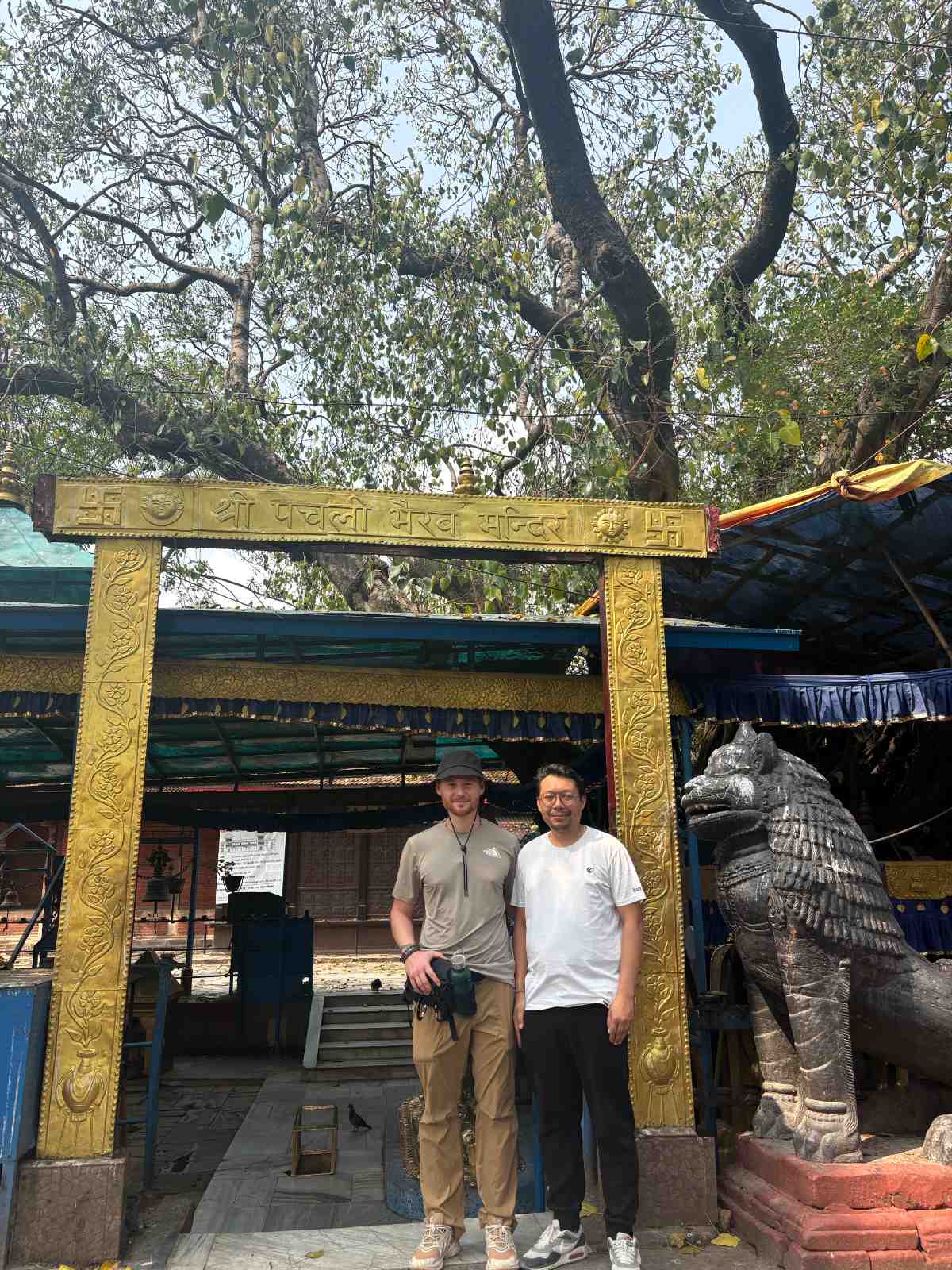
At the gateway of Pachali Bhairava, under the pipal that stands over the courtyard. The temple sits close to the line of the blade and is taken in on the way between seats.
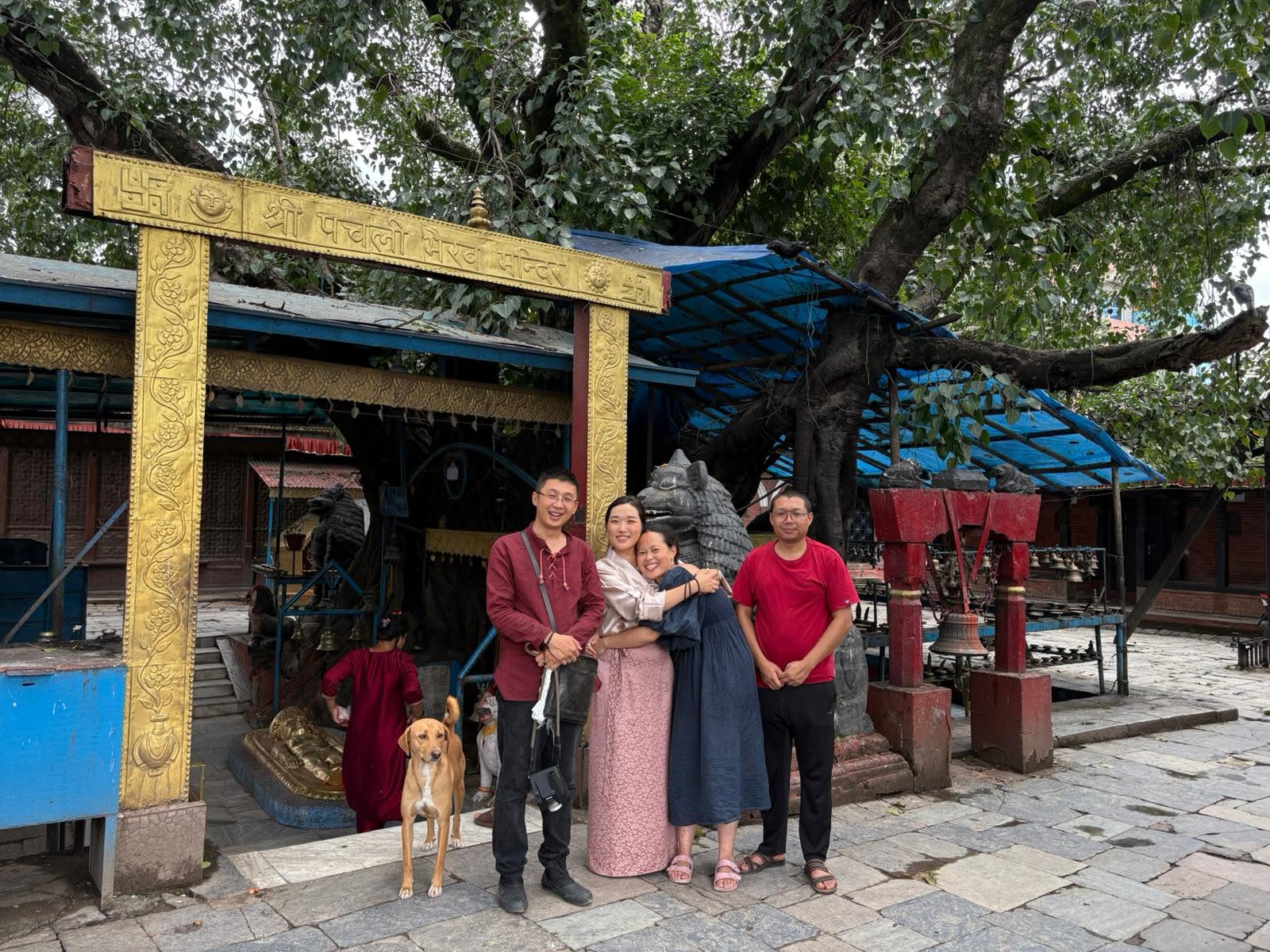
A group of pilgrims from China in the courtyard at Pachali, at the close of a morning on the circuit.
What matters more than the list of names is the sequence in which they are approached. The circuit has a direction. Where you begin, which way you travel around the blade, and where you bring the round to a close are what determine whether you have walked a maṇḍala or simply visited a number of temples over the course of an afternoon. The offerings are not the same from one seat to the next. Several of the shrines are unmarked from the street, or set back behind a courtyard entrance that anyone would walk past without a second look, and at some of them the observance made at the outer image is not the observance that carries the weight. There is also no single authoritative order to be had: it is held somewhat differently by different households and lineages, and publishing one version as though it were the version would misrepresent the tradition more than it would help anybody.
If You Are Going Independently
- These are living shrines, not monuments. Local families are carrying out genuine observances while you are standing there, and what they are doing takes precedence over your photograph in every case and without exception.
- Photography is restricted at several of the seats, and at some the restriction applies only to the inner image while the courtyard is fine. Ask before you raise the camera; a refusal is not rudeness, and asking will very often get you a yes.
- Go early. These shrines are at their most active between dawn and mid-morning, and that is also the window in which someone is likely to be present who can tell you what you are looking at.
- Devotional visiting is open to anyone. The local practice, though, is that a specific request made to a specific mātṛkā is taken up through a household priest or an astrologer who has looked at the case, rather than undertaken on one's own initiative.
Walking It With Me
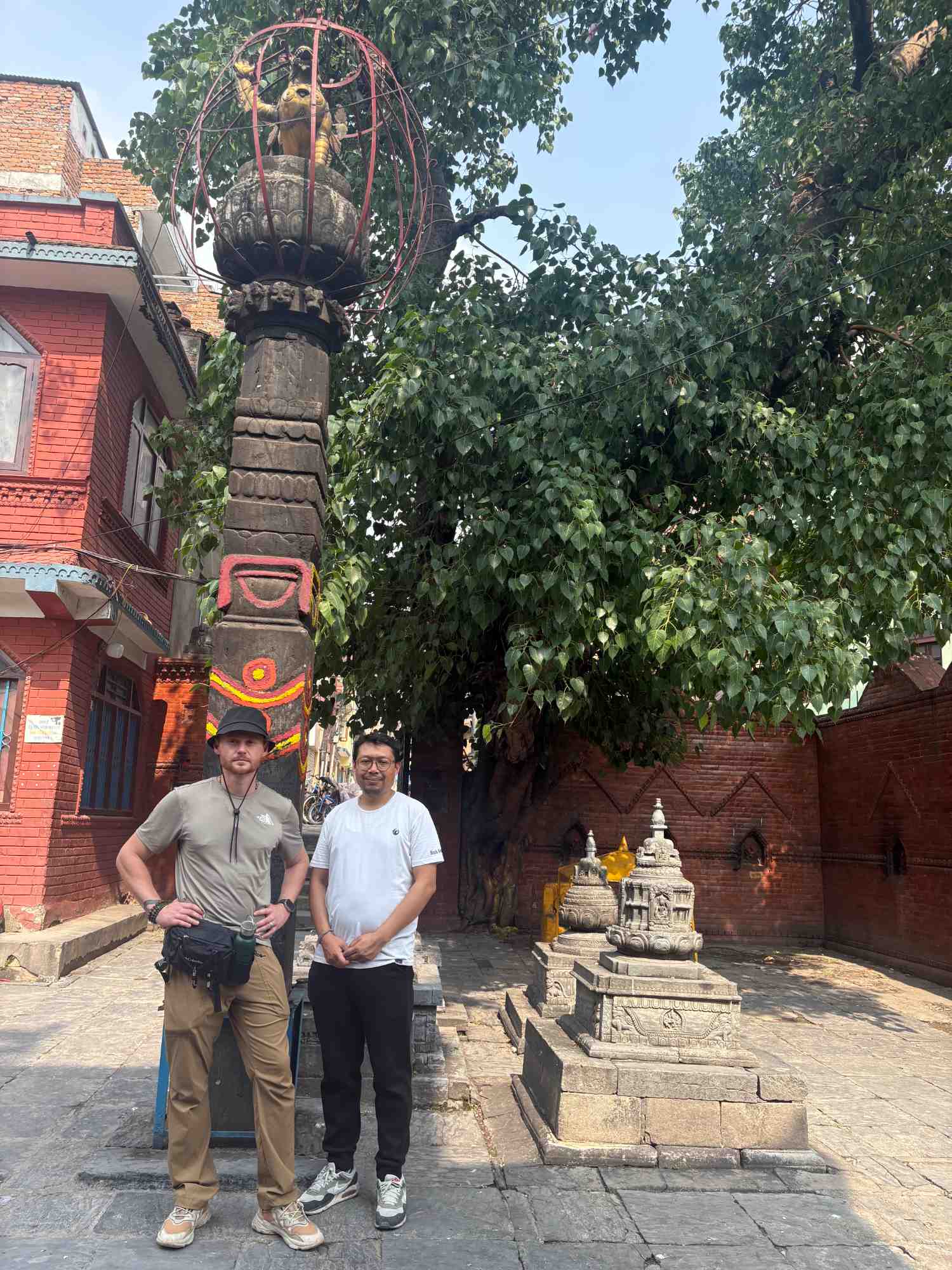
At Kaṅkeśvarī, beside the pillar and the votive caityas that stand in the courtyard — one of the temples the round takes in.
So far as I am aware, the mātṛkā circuit of Kathmandu is not offered as a guided pilgrimage by anyone else in the Valley. I have walked it with visiting scholars and with people who came to it for a particular reason of their own: the eight seats in their proper sequence, the temples along the line between them, and the accounts attached to each — who established the seat, what is held about her there, why she is approached as she is — which is the part that does not exist in print and cannot be picked up from the shrine itself. It is arranged on request, and the details are here: customized pilgrimage.