
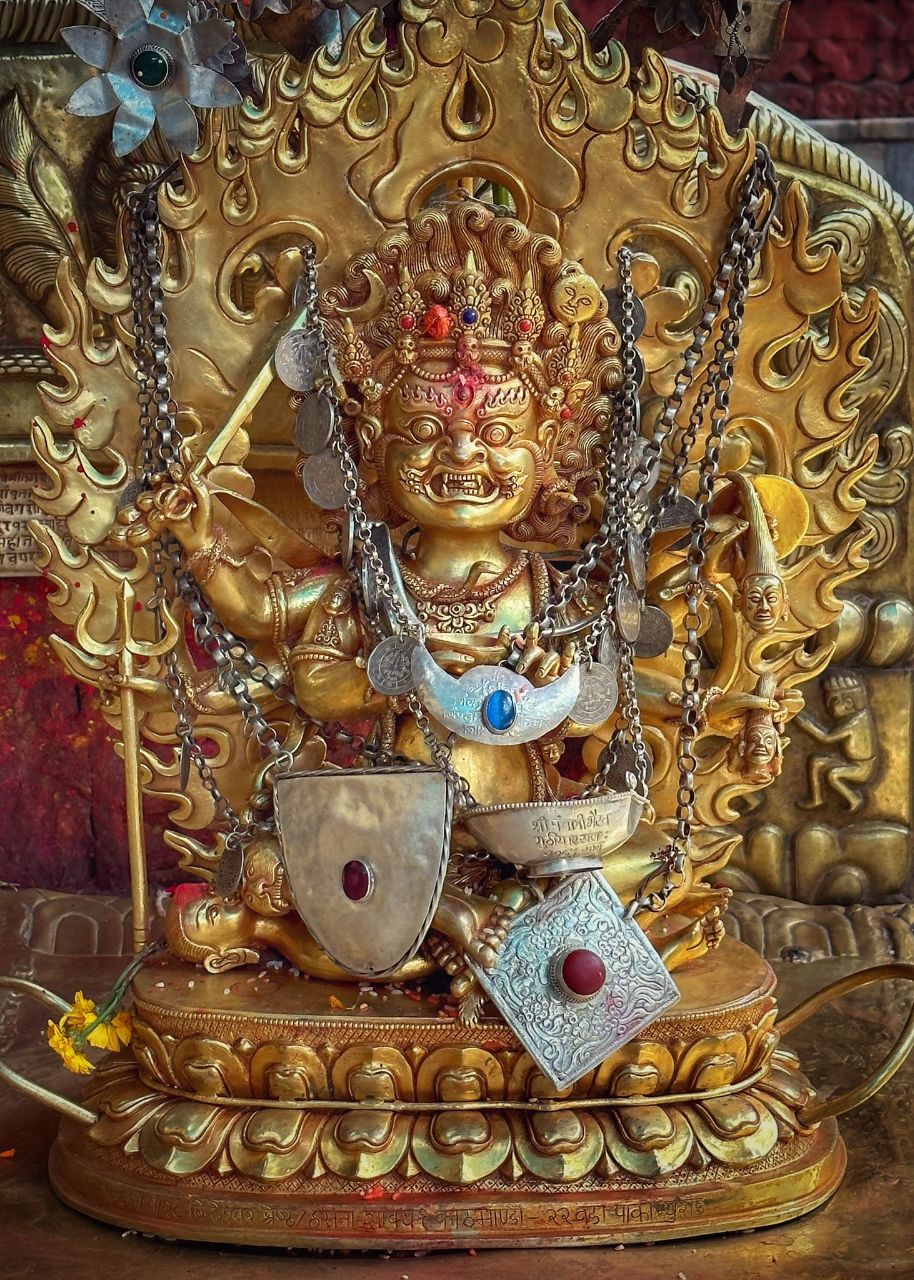
The Shrine at Teku
Pachali Bhairava stands at Teku, at the southern edge of old Kathmandu, in a courtyard held together by an enormous old tree. It is not a temple in the sense that most visitors expect — there is no towering tiered roof to photograph from across a square. What is there is a shrine set low among the roots, worked in gilded metal, surrounded by tridents and standing weapons and the accumulated offerings of a very long time.
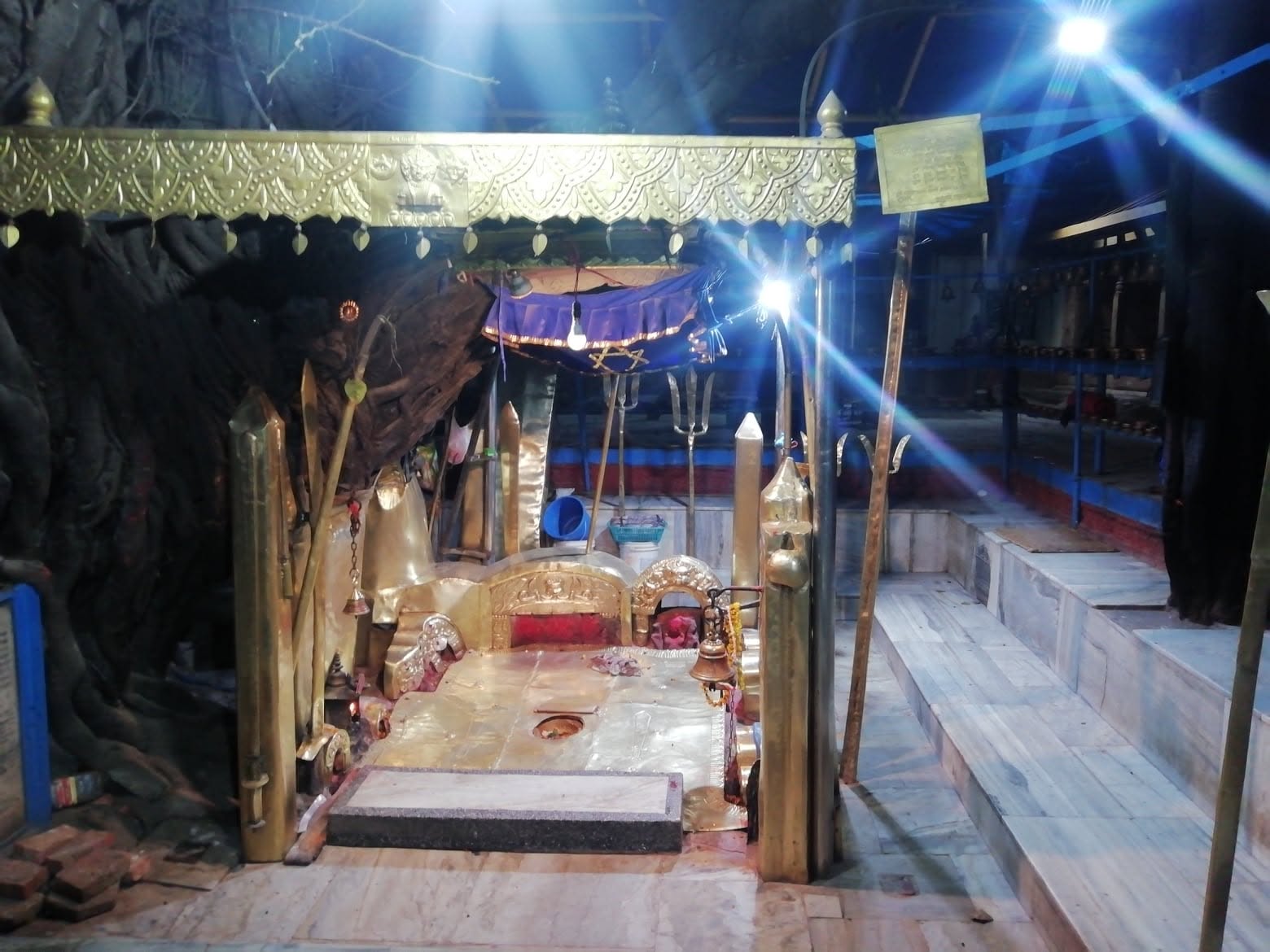
The shrine at the roots of the tree, with the tridents and standing weapons set around it.
It is a working shrine rather than a monument, and it is one of the places where we perform rituals on a regular basis.
The Story People Tell
There is an account of how Bhairava came to be at this spot that anyone in the neighbourhood can tell you, and it goes like this.
A king of Pharping fell in love with a local butcher girl. The king was a serious spiritual practitioner, and under his influence the girl began to practise as well. One night, in the course of their intimacy, he disclosed something he had not told her before: that he was able to transform himself into Bhairava.
She was thrilled by this and asked to see it. He put her off, and she asked again, and eventually he agreed. But he set a condition. He would give her blessed rice, and when he had taken the form she was to sprinkle it over him — otherwise he would not be able to return to his human shape.
She agreed, and on the appointed night he performed the practice and transformed. What appeared in front of her was so wrathful that she fainted where she stood, and the rice was never sprinkled. Unable to return to his own form, and unwilling to remain in the city in that state where the citizens might come to harm, he made his way to the spot where Pachali Bhairava now stands, and there he disappeared.
That is the story as it is ordinarily told, and it is the one you will hear if you ask.
There is a good deal more attached to this place — what the transformation actually consisted of, what the rice was, why this particular spot and no other — and that material is not published. There is nothing withheld for effect here. It is simply not something that circulates on the internet, and it is discussed on the ground, at the shrine, in the course of the Aṣṭa Mātṛkā round.
Where Pachali Sits in the Scheme
The eight mātṛkās of the Valley are not worshipped in isolation. In the standard arrangement each of the mother goddesses is paired with a Bhairava, and the two are understood together. Within that scheme, Pachali is associated with Svacchanda Bhairava.
This is the reason the shrine is taken in on the mātṛkā circuit rather than treated as a separate excursion. It is not a stop added because it happens to lie on the way. It belongs to the same structure as the eight seats, and a round that skipped it would be leaving out part of what it was walking through.
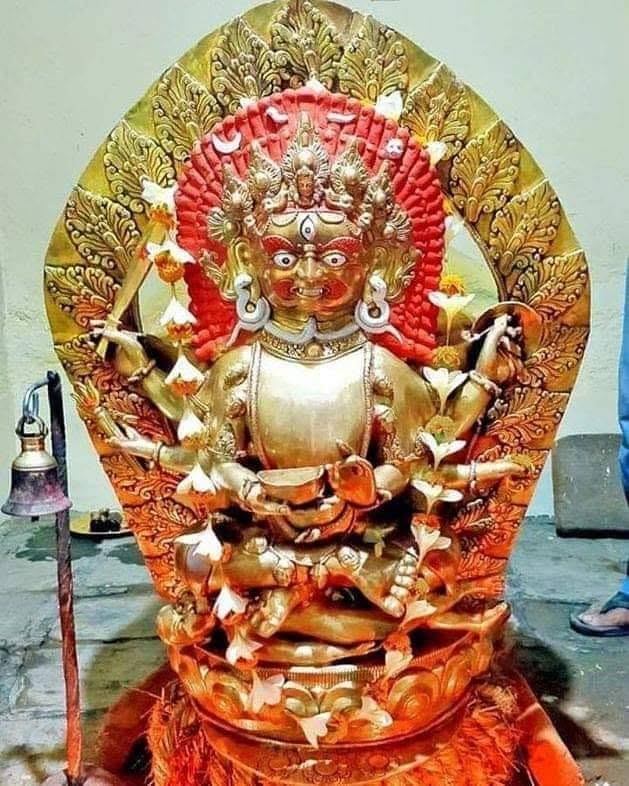
The wrathful form, gilded and ornamented.
Who Maintains It
The daily rituals at Pachali are performed by a local Vajrācārya priest. The Dongol community are the caretakers of the place and have held that responsibility for generations.
This division — a Vajrayāna Buddhist priest performing the daily observances at a Bhairava shrine, with a Newar farming community as its custodians — is entirely ordinary in Kathmandu, and it is worth noticing precisely because it would look anomalous anywhere else. The categories that separate Hindu from Buddhist, and priest from community, do not sit in the Valley where an outside observer expects to find them.
Pachali Bhairava is one of the temples visited on the Aṣṭa Mātṛkā circuit of Kathmandu, which I arrange and lead on request: customized pilgrimage.